Given the rise of technology in every area of contemporary life, home security systems have evolved significantly since the days of old locks and keys. Of these new devices, the fingerprint identity door lock is currently receiving great interest due to its security and convenience in both household and business-related applications. The application of these biometric systems is that they will overcome mechanical locks, leading to faster and smarter access control. But how practical and safe are they once we step into the real world?
This post will examine whether these locks truly offer better convenience and safety than traditional door locks, and what technology lies at the heart of every lock.
Understanding Fingerprint Door Locks
Fingerprint door locks are part of biometric security systems that identify a person by using their unique physical characteristics during authentication. These can include fingerprints, retinal patterns, and facial features. In this example, the lock reads and authenticates a person’s fingerprint to unlock.
Biometric locks, unlike their traditional counterparts, which operate through keys or PIN-based identifiers, analyze and match stored fingerprint images via pattern recognition technology. When a registered user rests their finger on the scanner, the print is compared with entries in encoded form in the database. If a match is acquired, the door is unlocked immediately.
Conventional devices are based on a combination of hardware elements (scanner, microprocessor, and locking hardware) with software-based algorithms that process the fingerprint images and grant access.
How Fingerprint Locks Work
There are a few sets of processes for the operation of the fingerprint lock, which can be completed within seconds:
- Fingerprint Enrollment: A finger is placed on the scanner, capturing a print image.
- Data Conversion: The image is algorithmically transformed into a digital form by recognizing and accentuating the ridges and depressions of the finger.
- How it works: A Digital template of the fingerprint S and a Fingerprint from the Finger Scanner are taken.
- Access Granted: If the template is found in the database, the door opens.
New generation thumbprint locks use optical, capacitive, or ultrasonic scanning. Capacitive sensors are particularly desirable for household and office applications due to their accuracy and resistance to spoofing.
NOTE:- The innovation of door locks with fingerprint had been embraced for offering high-level protection and seamless access. Home and business owners had relied on them for years. Prolux International LLC had stood out as a trusted provider. Reach out to Prolux International LLC to install your advanced fingerprint door lock today!
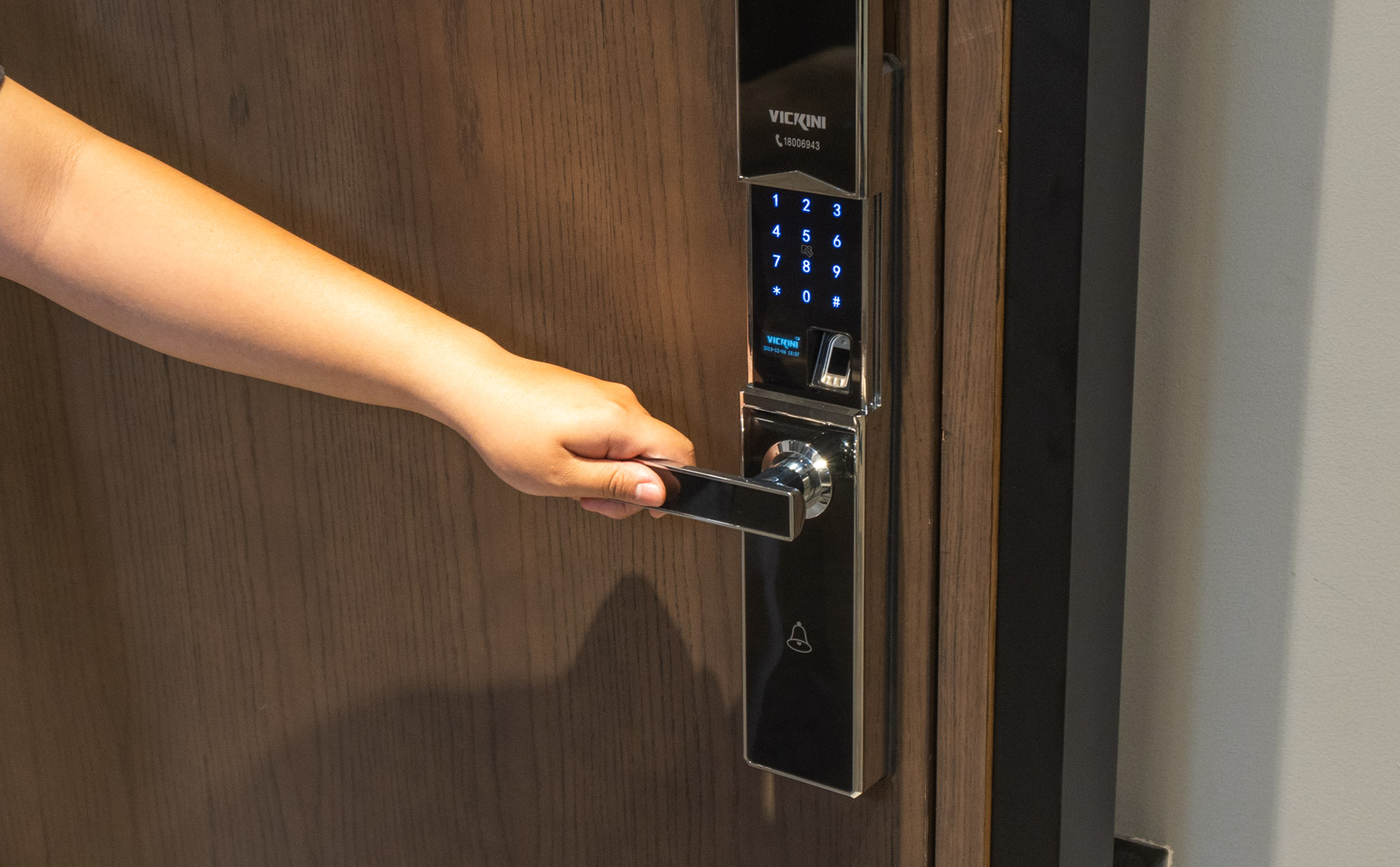
The Convenience Factor of Fingerprint Door Locks
Elimination of Physical Keys
The first predicted benefit of fingerprint door locks is the ability to eliminate the need for keys. Conventional keys can be misplaced, forgotten, or copied, causing inconvenience and compromising security. But a fingerprint, they explain, is always with you, so there’s less reliance on things and objects to get around.
Faster and Easier Access
A fingerprint does not press the issue of what you have done with your key in a two-second transformation from a locked door to an unlocked one. That makes biometric locks especially attractive to individuals who value speed, as well as hands-free access, such as families, business owners, and elderly users.
Multi-User Capability
Most modern fingerprint locks support multiple fingerprints to be entered, allowing the key to be shared among different family members, coworkers, or friends in a small office. Management can be simplified because access rights can be easily added or removed.
Integration with Smart Home Systems
(Most fingerprint locks are actually smart locks; they can be connected to a home automation platform, such as directly via Wi-Fi or Bluetooth.) This feature enables remote access and programming, as well as temporary access codes, along with an activity log.
Evaluating Safety and Security
As convenient as door locks are, security is the name of the game. The safety benefits of fingerprint locks on various aspects are well-proven, whereas the problems associated with their use are also new.
Biometric Accuracy and Uniqueness
No two fingerprints are the same—even between identical twins. With this unique feature, fingerprint locks offer a higher accuracy rate in recognizing their users. More sophisticated ones use multi-dimensional fingerprint mapping to measure depth and texture, making it harder to spoof the scanner with fake prints or photographs.
Protection Against Key Duplication
Traditional keys are easily duplicated at hardware stores, but fingerprints cannot be copied without more sophisticated and criminal means. This makes biometric locks a far safer option when it comes to security against unwanted access.
Audit Trails and Access Monitoring
Some of the modern fingerprint door locks keep a digital log of entry/ exit records. These logs can tell who enters the door and when; it is very useful in the access security management system of an office, data center, or high-security facility.
Combination with Other Security Measures
Fingerprint locks may also include other MFA. A lock might necessitate not just your print but a PIN, or a digit and phone confirmation. Such mixtures reduce the risk of system manipulation or hardware failures.
Potential Risks and Limitations
Although fingerprint locks offer cutting-edge security features, they are not invulnerable and are subject to flaws and failures.
Power or Battery Dependency
Many biometric locks are electronic and operate by battery or AC power. Users may be locked out temporarily if the power is cut or the battery dies. Most high-quality models will contain backup power or an emergency key access.
Environmental and Fingerprint Quality Factors
Fingerprint recognition may become unreliable, for example, depending on external factors such as humidity or soil. Likewise, people with eroded or injured fingerprints (typical in labourers) may have difficulty with scanning.
Privacy and Data Protection Concerns
Because fingerprint locks contain biometric information, there are concerns about data privacy and potential misuse. To protect against unauthorized access to fingerprint databases, trusted brands integrate encrypted storage and secure algorithms. However, users must check whether the selected system meets data protection requirements.
Cost Considerations
Fingerprint locks are usually more costly than standard locking devices. The cost depends on factors such as connectivity, material, and the amount it can carry. But the lifetime convenience, strength, and security of a better lock can make an upgrade totally worth it.
Comparison with Traditional Locking Systems
Mechanical Locks
Standard mechanical locks are inexpensive, easy to fabricate, and readily available, but there is one major drawback — keys have a tendency to get lost or stolen and can be easily copied. They also don't provide any way to keep a log of entries or remotely control the lock.
Electronic PIN or Card-Based Locks
The use of access cards or PIN codes in electronic locks leaned towards keyless entry. But they depend on memorization or physical cards, which can be lost. Fingerprint locks, on the other hand, are inherently linked to a user’s identification, resulting in no dependencies external to their operating domain.
Smart Locks without Biometrics
Smartphone- and Bluetooth-enabled smart locks bring digital ease, but their security relies on the device connection and the app’s own security. A fingerprint lock delivers more direct access, less prone to tampering because, while biometric data can be transferred or hacked over the internet, it can’t simply do so in a way that benefits an attacker.
Real-World Applications
Residential Homes
Homeowners are increasingly using fingerprint locks on front doors, bedrooms, and safes. They eliminate the need for keys, allowing family members to secure access, and they can be tied into smart home systems for remote surveillance.
Commercial Buildings and Offices
Fingerprint locks are used in enterprises to prevent unauthorized access to restricted areas, server rooms, and other sensitive locations. Managers can restrict access for employees and see activity logs to stay on track.
Educational Institutions
Biometric locks are the most widely adopted systems by schools and universities to control laboratories, libraries, and hostels, keeping unauthorized students or staff out of secure areas.
Hospitality Industry
Fingerprint locks for hotels are also suitable for in-room doors and staff areas, allowing them to enjoy a taste of luxury while maintaining safety and efficiency. The application streamlines check-in and lowers the risk of lost room keys.
Maintenance and Reliability
Fingerprint locks are low-maintenance but do require occasional maintenance for optimal performance. Frequent cleaning of the scanning surface is crucial to ensure high-quality scans. If you have battery-operated models, check them every few months to ensure the batteries are still functioning properly.
Software Firmware upgrades, when they become available, are also important for upgrading encryption strength and ensuring compatibility with forwarding devices, such as smart devices.
The Role of Technology Evolution
With the development of sensors and algorithms, fingerprint locks are becoming increasingly accurate, speedy, and durable. The best models rely on AI pattern recognition, which detects disturbances in the fingerprint and decreases false rejections. Whether you’re wearing gloves, dunk them in water, or use them in darker environments or weather conditions.
The lines are also getting blurred as some makers implement cloud-based access control systems that allow administrators to remotely add or delete users, review entry data, and respond to security alarms in real time.

Are Fingerprint Door Locks Worth It?
“Whether fingerprint locks are more ‘convenient’ or ‘safer is subjective, and varies according to personal demand and specific use environment. When it comes to simplicity, speed, and modern flair, this balance system is simply unrivaled in terms of ease of installation and the buttery smooth, quiet operation. For businesses, it offers traceability and more control.
However, users should also consider data privacy compliance, including which options can create a secure backup entry and which brands to trust for years of reliable use and protection.
Choosing the Right Fingerprint Lock
When selecting a fingerprint door lock, there are several key factors to consider.
- Construction: Go for a metal body armour, stainless steel, or metal alloy, to say the least.
- Type of sensor: Capacitive sensors or ultrasonic sensors have greater accuracy.
- Capacity: When purchasing, ensure the system is capable of storing the required number of fingerprint records for your specific use.
- Options to Connect: You can connect through WiFi or Bluetooth for monitoring with your mobile phone.
- Emergency Access: A mechanical key or backup code ensures access during power failures.
The Future of Biometric Security
Fingerprints are just the tip of the iceberg in a biometric revolution that is changing attitudes toward security worldwide. Future developments will include multimodal authentication, where fingerprints are combined with facial or voice recognition for even greater reliability.
Furthermore, high-end models are expected to support AI-based anomaly detection and real-time access analytics as a part of smart security platforms, offering adaptive security systems that can understand a user’s behavior. With technological advancements, prices are expected to drop further, and systems will become accessible to a broader consumer market.
Conclusion
To summarize, doors that store fingerprints for access are, in fact, more convenient and secure than standard locks. They streamline access control and eliminate the need for keys, while also providing consistent biometric authenticators that are not easily copyable.
Although there are challenges in terms of cost, power dependence, and privacy concerns, the advantages outweigh them. With technological advancements in recent years, fingerprint locks are expected to become part of the mainstream smart security system, offering convenience and peace of mind to households and businesses alike.
Overall, this transition to fingerprint door locks represents an important step towards that keyless future, one where a key is not just accepted for access but intelligently recognized.